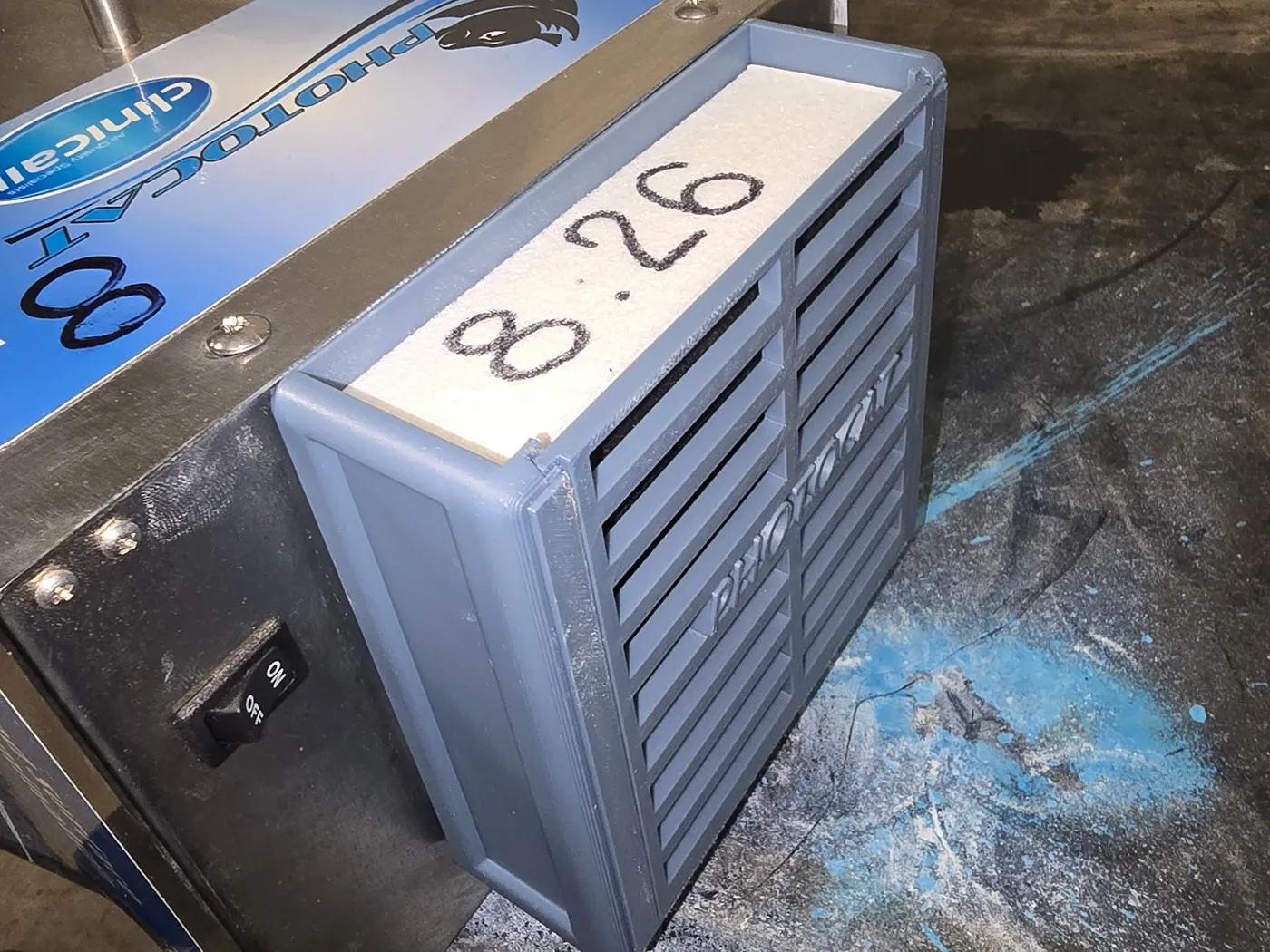
Manufacturing equipment rarely follows a standard template. As machines become more specialized and production environments become increasingly automated, engineers often encounter situations where an off-the-shelf component simply does not provide the right fit.
Custom fan enclosures are a good example.
Fans are used throughout manufacturing equipment and industrial systems to manage airflow, cooling, ventilation, and temperature. However, the enclosure surrounding a fan may need to fit into a very specific space or integrate with other components within a larger assembly.
This is where additive manufacturing and engineering design can provide a practical solution.
A fan enclosure is designed to house, protect, and integrate a fan into a piece of equipment or manufacturing system. Depending on the application, it may direct airflow, protect the fan from surrounding equipment, provide a mounting structure, or connect the fan to another component or duct.
A standard enclosure may work for a common application, but specialized manufacturing equipment often requires something different.
The enclosure may need to accommodate an unusual fan size, restricted mounting area, custom ducting, electrical components, or other equipment surrounding the fan. Rather than redesigning the machine around a standard product, engineers can use additive manufacturing to create an enclosure specifically for the application.
The biggest advantage of additive manufacturing in this type of application is design freedom.
Because 3D printing builds components layer by layer directly from a digital model, engineers can produce geometries that would be difficult, expensive, or inefficient to manufacture using conventional methods.
A custom fan enclosure can be designed with mounting brackets, ventilation openings, curved transitions, cable channels, fastening points, protective grilles, and connection interfaces incorporated directly into the component.
This allows the enclosure to become an integrated part of the overall equipment design rather than a separate component that has to be adapted to fit.
At 3D ForgeHub, custom 3D design services use CAD modeling and engineering expertise to develop detailed models based on the requirements of each application. This design-first approach is an important part of turning 3D printing into a manufacturing solution rather than simply a method of producing prototypes.
Custom fan enclosures can provide several practical advantages within a manufacturing environment.
A purpose-built enclosure can improve how a fan integrates with surrounding machinery, while custom geometry can help manage airflow and make better use of the available space. The enclosure can also be designed around the equipment's existing mounting points and service requirements.
Additive manufacturing makes it easier to produce these customized components without relying on specialized tooling.
This can be especially useful when equipment is produced in relatively small quantities, when a replacement component is needed quickly, or when an engineering team is developing a new machine.
Rather than waiting for a conventional fabrication process to accommodate a highly customized design, engineers can move from CAD to a physical component through an efficient additive manufacturing workflow.
Engineering design is rarely a one-step process.
A fan enclosure may require adjustments after installation or testing. Airflow may need to be redirected. A mounting point may need to move. An opening may need to be enlarged, or the overall enclosure may need to be modified to accommodate another component.
With 3D printing, these changes can be made within the CAD model and incorporated into a subsequent production run.
This ability to iterate is one of the defining advantages of additive manufacturing. 3D ForgeHub's services support projects ranging from rapid prototypes and custom designs to production-ready parts and bulk manufacturing.
A custom fan enclosure may seem like a relatively simple part, but it demonstrates an important principle of modern manufacturing: the most useful component is not always the one that is easiest to manufacture using conventional methods.
Additive manufacturing gives engineers the ability to design according to the requirements of the machine rather than the limitations of a standard component.
That means a fan enclosure can be developed around the available space, airflow requirements, mounting configuration, surrounding equipment, and intended operating environment.
The result is a component designed specifically for the job.
At 3D ForgeHub, we combine custom engineering design with industrial 3D printing to help manufacturers turn specialized requirements into functional parts. Our capabilities include custom 3D design, rapid prototyping, additive manufacturing, and production of custom components for industries including engineering and manufacturing.
For manufacturers looking to improve an existing piece of equipment or develop a new system, custom fan enclosures are just one example of what is possible through additive manufacturing.
From the initial concept through CAD development, prototyping, and final production, 3D ForgeHub can help transform an engineering requirement into a practical 3D printed component.
Have a custom enclosure, housing, duct, or manufacturing component in mind? Contact 3D ForgeHub and let us help bring the design to life.

At 3D ForgeHub, innovation and precision come together to deliver professional 3D printing and additive manufacturing services in Waterloo.
With more than a decade of experience in manufacturing, engineering, and advanced 3D design, our team specializes in producing high-quality custom 3D printed parts, rapid prototypes, and small-batch manufacturing solutions for businesses and individuals across Canada.
©Copyright 3D ForgeHub - All Rights Reserved
Website by Liquid Media Studios